Library 2026-05-26

Rating: Not rated
Tags: Fantasy, Fiction
Summary
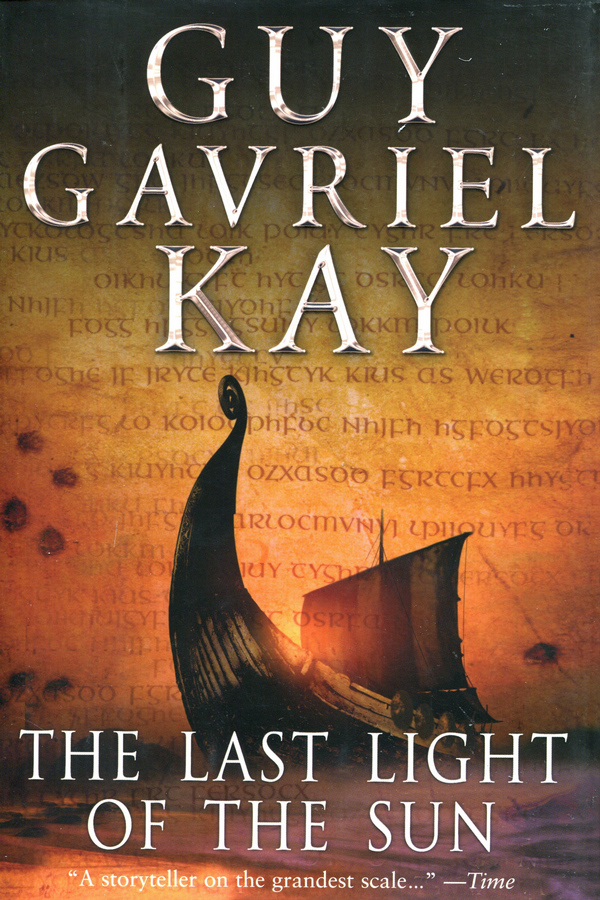
The Last Light of the Sun is a 2004 fantasy novel by Guy
Gavriel Kay. Like many of his books, it is set in a world
that draws heavily upon real times, events, places and
people. In this particular book, the period is the Viking
invasions of Saxon England. The story concerns a young
Erling's attempt to prove himself as a warrior, his father's
attempts to make amends for his mistakes, a young prince
searching for revenge and a King's attempt to transform his
realm into a more civilized one that will resist attacks from
the Erlings forever. The books main themes are revenge,
violence, the passing of an era, clash of cultures, and love
— especially between father and son. The Last Light of
the Sun is set in the same world as Kay's The Lions of
Al-Rassan and The Sarantine Mosaic novels, taking place after
the Sarantine Mosaic but before Lions. Read more -
Shopping-Enabled Wikipedia on Amazon
In the article: Plot | Reception |
Awards
In this wonderfully imaginative historical fantasy from
Kay (A Song for Arbonne), seemingly random deeds connect
Erling (Viking) raiders and Anglcyn (English) and Cyngael
(Welsh) princes: If only Bern Thorkellson hadn't stolen that
horse in a desperate act of vengeance against his sorry fate;
if only Dai ab Owyn hadn't stepped outside the safety of
Brynfell right at the moment when the Erlings attacked; if
only Ivarr Ragnarson hadn't been born ill-formed and
downright cruel; if only Aeldred hadn't been king of the
Anglcyn; if only Thorkell Einarson had murdered only one man
and not the second; if only Alun ab Owyn hadn't stepped into
that pool on a moonless night and seen the Queen of the Elves
in procession. At first glance, each individual's act appears
to be a normal human response. It's only later, as the
characters' paths cross, that the pieces come together to
weave a dazzling tapestry of conjoined fates. Solid research,
filtered through vibrant prose, serves to convey a sense of
how people really lived and died in Viking and Anglo-Saxon
times and how they might have interacted with the realm of
magic on a daily basis. Readers of lighter fantasy should be
forewarned—the novel contains a lot of gruesome killing
and the fairy world plays a relatively minor role, as do
women.
From Wikipedia
From Publishers Weekly
Copyright © Reed Business Information, a division
of Reed Elsevier Inc. All rights reserved.