Library 2026-05-26

Rating: Not rated
Tags: Fiction, Fantasy
Summary
"You must be as sharp as a stilettotore’s dagger and
as subtle as a fish beneath the waters. This is what it is to
be Navolese, this is what it is to be di Regulai." In Navola, a bustling city-state dominated by a handful of
influential families, business is power, and power is
everything. For generations, the di Regulai
family—merchant bankers with a vast empire—has
nurtured tendrils that stretch to the farthest reaches of the
known world. And though they claim not to be political, their
staggering wealth has bought cities and toppled kingdoms.
Soon, Davico di Regulai will be expected to take the reins of
power from his father and demonstrate his mastery of the
games of Navolese diplomacy: knowing who to trust and who to
doubt, and how to read what lies hidden behind a smile. But
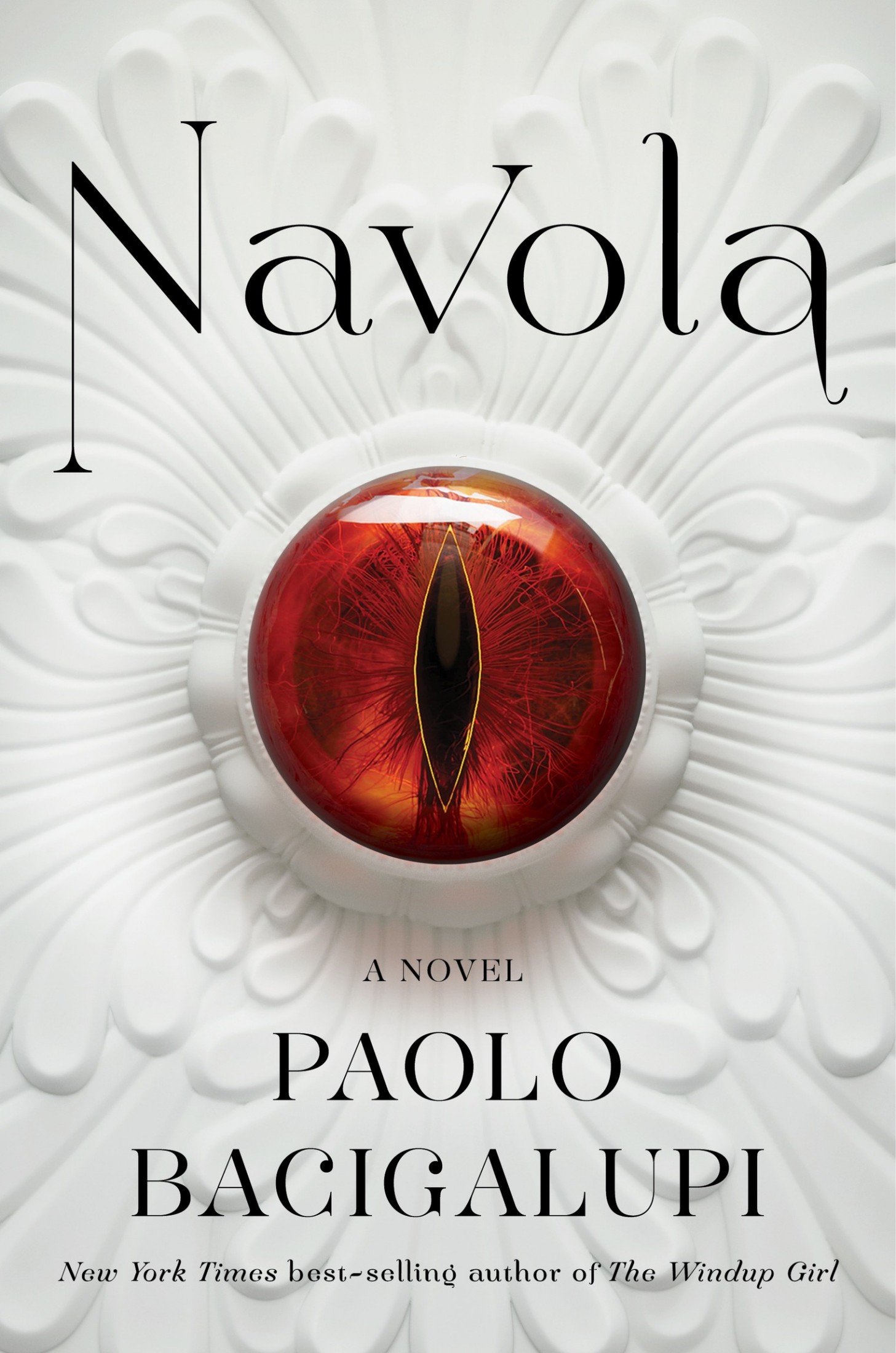
in Navola, strange and ancient undercurrents lurk behind the
gilt and grandeur—like the fossilized dragon eye in the
family’s possession, a potent symbol of their raw power
and a talisman that seems to be summoning Davico to act.
As tensions rise and the events unfold, Davico will be
tested to his limits. His fate depends on the eldritch dragon
relic and on what lies buried in the heart of his adopted
sister, Celia di Balcosi, whose own family was destroyed by
Nalova’s twisted politics. With echoes of Renaissance
Italy,
The Godfather , and
Game of Thrones ,
Navola is a stunning feat of world-building and a
mesmerizing depiction of drive and will.
Praise for Paolo Bacigalupi's
Navola
"Steeped in poison, betrayal, and debauchery, reading
Navola is like slipping into a luxurious bath full
of blood."
** “Medici Florence meets Tony Soprano’s New
Jersey—with a delicious dash of high fantasy and a
heavy splattering of blood.
Navola is a grand feat of imagination by a
storyteller at the peak of his powers.”
“Compelling and thoroughly immersive. . . .
Bacigalupi has long been skilled at drawing characters
seeking equilibrium while being buffeted by forces beyond
their control, and Davico may be his strongest such character
yet. . . . [
Navola is] undeniably new territory for Bacigalupi,
and it’s a pleasure to report that his most impressive
narrative strengths have ported over intact.”
“Lots of epic fantasies get compared to
Game of Thrones these days. But this sweeping
literary tale of the young heir of an influential banking
family who faces rebellion as he ascends to power in a world
inspired by 15th-century Florence might actually deserve
it.”
“Bacigalupi dazzles in this addictive account of the
rivalries between powerful families in a brilliantly rendered
fantastical world inspired by 15th-century Florence . . .
Admirers of
Game of Thrones and Dorothy Dunnett’s House of
Niccolò series will be riveted.”
“Politics, passion, poison, blood, and betrayal are
melded into a masterful fantasy epic of nonstop action that
is just begging for a sequel. All of the [science fiction /
fantasy] fan-favorite Bacigalupi hallmarks are here: deep
character development and astounding world-building, but this
time with dragons.”
“Bacigalupi’s new genre-bending fantasy is a
coming-of-age tale set in a mob-like family, full of
intrigue, betrayal, and the lust for power, status, and
money. For readers who enjoy fantasy full of political and
family intrigue, such as
A Game of Thrones by George R.R. Martin, and for
those who like coming-of-age stories focusing on a young
man’s battles, such as
The Name of the Wind by Patrick Rothfuss.”
PAOLO BACIGALUPI is the author of
The Water Knife and
The Windup Girl, as well as the YA novel
Ship Breaker, which was a finalist for the National
Book Award. He has won a Hugo and a Nebula Award, the
Theodore Sturgeon Memorial Award, the John W. Campbell
Memorial Award, and he is a three-time winner of the Locus
Award. He lives in Colorado.
Review
—Holly Black, #1 New York Times
**bestselling author
—Dan Jones, New York Times
best-selling author of Essex Dogs
—Gary K. Wolfe, Locus
— Paste Magazine,
“The Most Anticipated Fantasy Books of Summer
2024”
— Publishers Weekly
, starred
— Booklist,
starred review
— Library Journal
About the Author